Over the years, I've participated in my fair share of the typical
build/fly, where a few BAR's get in front of a group of scouts, church group, school kids, etc. and lead them through
construction and flight of a model rocket. I've also worked with a number of TARC teams getting into more complex
designs and flight objectives. I've managed to work with just about every imaginable group of kids out there, except
that in the 12 years my wife has been a school teacher, I have never worked with her kids. With the EMRR Youth
Participation Contest, coupled with an upcoming job change that would make it much more difficult to break away during
the school day, it seemed as though fate was telling me it's about time to bring rocketry into the wife's classroom.
You see, my wife is a Special Education teacher, working with kids showing a
combination of physical and/or mental disabilities. These are kids that might have autism, Down's Syndrome, etc. and
varying cognitive age ranges from 3-year-old to pre-teen. School systems tend to swing back and forth along a pendulum
between trying to integrate these kids into the mainstream classrooms (inclusion) and providing separate/specialized
education (exclusion), and in this school system the objective is to provide as much of their education integrated with
the regular school population as possible. With that in mind, I thought it would be a great idea to provide them with
an opportunity to build and fly a model rocket at school.
In order to help get everyone excited about the project, on the big day my wife
played a video of the National Sport Launch from 2003 in her class. By the time I showed up, they were primed and had a
seemingly endless supply of questions for me. One young boy often had to remind me that today was a special day-we were
going to the park! I told him I'd try to make sure we didn't forget that part.
I started out with a brief explanation about the neat things rockets
do for us today--serving as workhorses carrying people and satellites into space, and describing the impact that
satellites have on our life today. I then showed a really neat 9-minute video animation of one of my favorite space
missions-the Mars Rover
I explained what was happening at the various stages of the mission.
The kids really seemed to enjoy watching the airbags deploy and seeing the giant ball bouncing along the surface of
Mars as the rover settled into its final destination.
After the video, we moved into show and tell, covering the basic components of a
typical rocket, how it works, and even getting a little bit into flight stability. After using an ordinary 3-fin
standard rocket to illustrate this, I then pulled out a number of other models to show different approaches, including
monocopters and a few gliders. The Semroc Mars Lander was a favorite. Anticipating the question of "what's the
biggest rocket you've ever built", I brought along my recently completed Q-Modeling Andromeda, which at a little
over 6 feet tall is one of my tallest models, and certainly one of the coolest. I couldn't let that steal the
spotlight, though, without also going micro, so I passed around a Fliskits' Big Honkin' Rocket, a mere 3" tall.
One of the kids asked how high it flies, and I laughed and had to admit that I had no idea-after about 50 feet, it's
impossible to see and flies too fast. I have to fly on short grass and look for the fluorescent color to have any
chance of getting it back.
After wrapping up the show & tell, I started passing around the kits for the
build session. As much as I prefer models that help teach craftsmanship skills like cutting and sanding fins, painting,
etc., I needed to keep this to about an hour and had to also make sure the skills required were reasonably within the
capabilities of the kids with physical disabilities. I decided to go with Quest Loadstars, an E2X class of rocket that
Quest had produced for a company as a promotional item. I had picked up a dozen at an auction a few years ago, and it
looked like an excellent fit for this group.
We began construction with the motor mount. Quest's motor mount design is great
for beginners-each of the parts are color-coded, so I was able to lead them through picking up the yellow tube, gluing
the red (outer) centering rings to it, then the blue thrust ring inside. There were six kids building, assisted by
myself, my wife and an instructional aide, so things moved at least as quickly as with any other build session I've
been involved with.
The shock cord is a combination of Kevlar and elastic, anchored around the motor
mount. The kids seemed impressed to know they were working with the same type of material used to make bulletproof
vests.
In order to allow the glue a few minutes to dry, we set the motor mount
assemblies aside and moved on to the nose cone. It's a simple two-piece assembly consisting of the nose/shoulder, and a
plastic end cap with eyelet for the shock cord. This required a touch of plastic cement, eliciting a few giggles and
complaints over the smell, as well as a warning from Teacher that this would not taste as good as the wood glue.
With the nose cone out of the way, we moved to the fin can, one of the features
that attracted me to this model in the first place. It's an ordinary 4-fin plastic fin can, though like the nose cone,
it's pre-colored so no painting is necessary. It also includes a built-in launch lug, so there's no additional gluing
or alignment necessary. Finally, it fits very snugly over the body tube, so while gluing is recommended, for most
low-powered flight the friction fit is sufficient. We had the fins taken care of in a matter of minutes.
Still looking to kill a little time for the motor mounts to dry, we assembled the
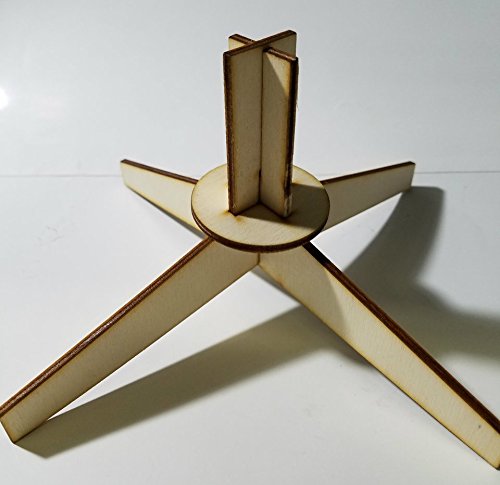
neat little plastic display stand that is provided with these kits. It's one of Quest's regular 2-piece slotted
stands-just slide one piece over the slot in the other, and it's ready for the rocket. Three of the kids had figured
this one out on their own before I'd even had a chance to point it out.
Finally, we had to tackle the one aspect of the build I really don't enjoy-the
dreaded parachute assembly. I really wanted to go with a plastic streamer instead of a chute, but figured the chute
would be a little more popular with the kids, and had even planned on assembling most of them myself the night before.
Life happened, though, and I didn't have time for pre-assembling, so we built them as a group. It really wasn't that
bad-the kids handled the sticker duty, applying the reinforcement tabs over the chute holes, and the adults worked the
shroud line knots. A couple of the kids were able to do most of the knots themselves, but for the most part the adults
were muttering about how fun tying all those little knots was turning out to be.
By this point, the motor mounts had dried and we were
able to then glue them into the body tubes. Our construction was done. We then turned to the decorating phase. The kit
comes with a few peel & stick decals, which most of the kids chose to use, but being kids, they also chose to add
their own personal touch with a liberal dose of Sharpie colored pens. As with most groups of kids, waiting a day or
more between the "build" and the "fly" portions of build/flys is a lot like asking a kid to get
some sleep the night before Christmas. I wanted to avoid driving everyone nuts by delaying the flight, so in planning
this session my wife and I scouted the neighborhood for launch sites rather than bring them to a later club launch.
There was a decent ball field right at the school, but the surrounding trees looked like they would almost certainly
claim at least one rocket, so we decided to go with a neighborhood park that was a little more open, but about a 15
minute walk from the school. This would give the kids a chance for a little field trip, plus bought me a little time to
drive on my own and get there with time to set up the pad, launcher, and prep the motors for the flights. As I was
setting up, a city groundskeeper approached me and asked what I was doing. After a brief panic wondering if I would be
in trouble for not getting some sort of permit, I explained that I was setting up for my wife's kids to come fly the
rockets they'd just built. He thought that sounded like fun, and asked if it would be OK if he hung around and watched.
With that hurdle cleared, I finished setting up just as the kids approached.
Rather than haul out our club's gear, I went low footprint and lightweight for
the launch gear, using a basic Estes porta-pad with a 1/8" rod, and for the launcher I used a Mercury Engineering
"Igniter Lighter" 12-volt system hooked up to my car's lighter socket. I picked this up from Jonrocket/com,
and have been very impressed with the quality-40 feet of launch cord plus 10 feet of power cord, safety key, continuity
check, etc., and packs in a small box. We set up with me loading the rockets, and either my wife or the instructional
aide supervising the safety key and launcher. It was a key objective for us to not only have the kids involved in the
build, but also allow them to push the button launching their own rockets.
We took turns with the kids each bringing their rocket up one by one. I
had provided A8-3's for the flights, and with winds puffing up to 6-8 mph, short/simple recovery was the goal. The
first rocket shot off without a hitch, arced over at about 75 feet, then deployed the chute. It was a little chilly,
and I had packed the plastic chutes a bit tight, so the chute didn't wind up unfurling until just before the rocket hit
the ground, but on the soft grass, everything was fine. We had a near miss, though, as I hadn't realized there was a
fenced off train track about 50 feet behind the pad, and the wind pushed this right to the "warning track". I
angled the rod a bit farther out for the second flight.
The next couple flights were slightly less stressful, with parachutes struggling
to deploy at such low altitudes, all recovered within a few feet of the pad. Our 4th flight, though, not only managed
to fully deploy the chute, but caught the front end of a small thermal and was pulled along by the ensuing draft just
over the fence and beyond the train track. The young girl was not exactly heartbroken, calmly accepting that the rocket
gods are fickle and had claimed her rocket. Our final flight of the day was another warning track shot, but safely
recovered.
As we packed everything up to head back to the school, one of the kids came up to
me to hand me his rocket. When I explained that it was his to keep, and could be re-flown, he lit up. I had made sure
each child got a handout with rocketry basics, information on finding gear and materials, and a link to our club's
website with launch schedule where kids are always free to fly using our gear.
Once we got back to the classroom, I followed up with one last handout-beautiful
full-color certificates commemorating their first flights. For those not aware of this, the NAR is celebrating its 50th
year of model rocketry, and is promoting a campaign to help 50,000 children build and fly their first rocket. They have
made a PDF file available at http://www.nar.org/pdf/50KAward.pdf that can be used to print out certificates to hand out
at launches. The kids seemed to be as thrilled by the certificate as the rocket itself!
On the way home, I decided to swing by the quarry next to the park and see if we
could find the one wayward rocket. As my wife and I trolled up and down the lot, she spotted the yellow and orange
chute in the brush. We were both overdressed for climbing across a wet/muddy trench, up a thick hill with 4-5 feet of
weed growth, but teachers tend to do just about anything for their kids, and my wife is no exception. She trudged
through the quicksand-like muck, slipped a couple times on the hill, but came back with the prized rocket to save the
day.
Usually after a build/fly, I tend to look back at the group and wonder if we've
inspired a future astronaut or aerospace engineer, or at the very least sparked the interest of someone who will
participate in TARC or pick up model rocketry as a hobby. In this case, I am probably not dealing with future
astronauts, but the expressions on these kids' faces as they watched their rockets launch was more rewarding than any
other build/fly I've been involved with. It was a special program in every sense of the word.